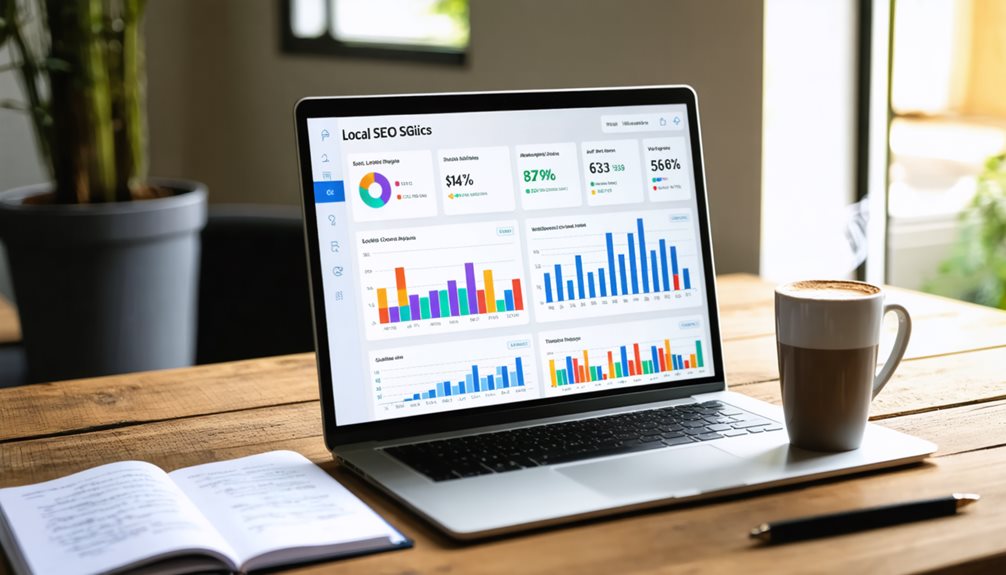
To enhance your local business's visibility, focus on these five technical SEO tactics. First, optimize your Google My Business listing with accurate information and engaging photos. Next, guarantee NAP consistency across all platforms to boost credibility. Implement schema markup on your website to help search engines understand your content better. Speed matters, so improve your website's load times by optimizing images and using caching. Finally, prioritize mobile optimization for a seamless user experience. Each tactic plays a significant role in driving traffic and building trust, and there's always more to explore to elevate your business's online presence.
Optimize Google My Business
To effectively attract local customers, you should regularly optimize your Google My Business (GMB) listing. Start by crafting a compelling business description that succinctly conveys what you offer and why you stand out. This isn't just about keywords; it's about telling your story in a way that resonates with your community. Highlight unique services, values, and any promotions that might draw people in.
Next, focus on customer reviews. They considerably influence potential customers' decisions. Encourage satisfied clients to leave positive feedback and respond to reviews, both good and bad. This engagement shows you care about customer satisfaction and builds trust with prospective clients.
Additionally, make sure your GMB listing is complete with accurate hours, location, and contact information. Use high-quality images that showcase your business, products, or services. Regularly update your listing with posts about upcoming events or news to keep your audience informed and engaged.
Ensure NAP Consistency
After optimizing your Google My Business listing, the next step is guaranteeing NAP consistency across all platforms. NAP stands for Name, Address, and Phone number, and its accuracy is essential for local SEO success. Inconsistent NAP details can confuse search engines and potential customers alike, leading to decreased visibility and trust.
Start by auditing your existing citations online. Check directories, social media profiles, and any other platforms where your business is listed. Look for discrepancies in your NAP information and correct them to maintain uniformity. This process is known as citation management, and it's critical for maintaining NAP accuracy.
Consider using tools like Moz Local or Yext to streamline this process, as they can help you monitor and manage your citations more efficiently. Consistency signals to search engines that your business is credible and reliable, which can positively impact your rankings in local search results.
Don't overlook the importance of keeping your NAP details updated, especially when you change locations or contact information. A small oversight can have significant ramifications, so prioritize NAP consistency to enhance your local SEO strategy.
Implement Schema Markup
Implementing schema markup is a game-changer for local businesses looking to boost their online visibility. By adding structured data to your website, you help search engines understand your content better, which can lead to enhanced search results. This markup enables you to specify schema types relevant to your business, such as LocalBusiness, Product, or Service.
Using these schema types, you can create rich snippets—those visually appealing search results that stand out. Rich snippets can display star ratings, prices, and even business hours, making your listing more attractive to potential customers. When users see that extra information, they're more likely to click through to your site.
To get started, use Google's Structured Data Markup Helper. It guides you through the process of adding schema markup to your webpages. Once you implement it, validate your markup with the Structured Data Testing Tool to verify everything's working correctly.
The payoff? Better visibility in search results, increased click-through rates, and ultimately, more customers walking through your door. Don't miss out on this opportunity to elevate your local business's online presence through effective schema markup.
Improve Website Speed
Website speed is essential for local businesses aiming to capture online traffic and convert visitors into customers. When your site loads slowly, potential clients may bounce before they even see what you offer. To boost your website speed, start by implementing website caching. This technique stores frequently accessed data so that returning visitors experience quicker load times. It's like having a shortcut to your content, enhancing user experience and reducing server load.
Next, focus on image optimization. Large image files can considerably slow down your site, so consider compressing images without sacrificing quality. Tools like TinyPNG or ImageOptim can help you streamline your visuals, making them faster to load. Additionally, use appropriate file formats—JPEGs for photos and PNGs for graphics—to optimize further.
Finally, regularly monitor your website's performance using tools like Google PageSpeed Insights or GTmetrix. They'll provide valuable insights into what might be slowing you down. By prioritizing website speed through effective caching and image optimization, you'll not only improve user experience but also enhance your website's SEO performance, ultimately leading to higher conversion rates.
Mobile Optimization Strategies
As you enhance your site's speed, it's also essential to guarantee it's mobile-friendly. A responsive design is non-negotiable; it makes certain your website adapts seamlessly to different screen sizes. This adaptability not only meets user expectations but also improves your search rankings. Google prioritizes mobile-first indexing, so if your site isn't optimized for mobile, you're likely missing out on valuable traffic.
Next, focus on your user experience. Simplified navigation is key; users should effortlessly find what they're looking for without zooming or scrolling excessively. Large buttons and clear calls-to-action make interactions easier, especially on small screens.
Additionally, consider image optimization. Compress images without sacrificing quality to enhance loading times on mobile devices. Test your site frequently on various devices to identify and rectify any usability issues.
Lastly, leverage tools like Google's Mobile-Friendly Test to assess your website's performance. By prioritizing responsive design and enhancing user experience, you'll not only cater to mobile users but also position your local business for greater success in today's digital landscape. Remember, a well-optimized mobile site can greatly boost your engagement and conversions.